
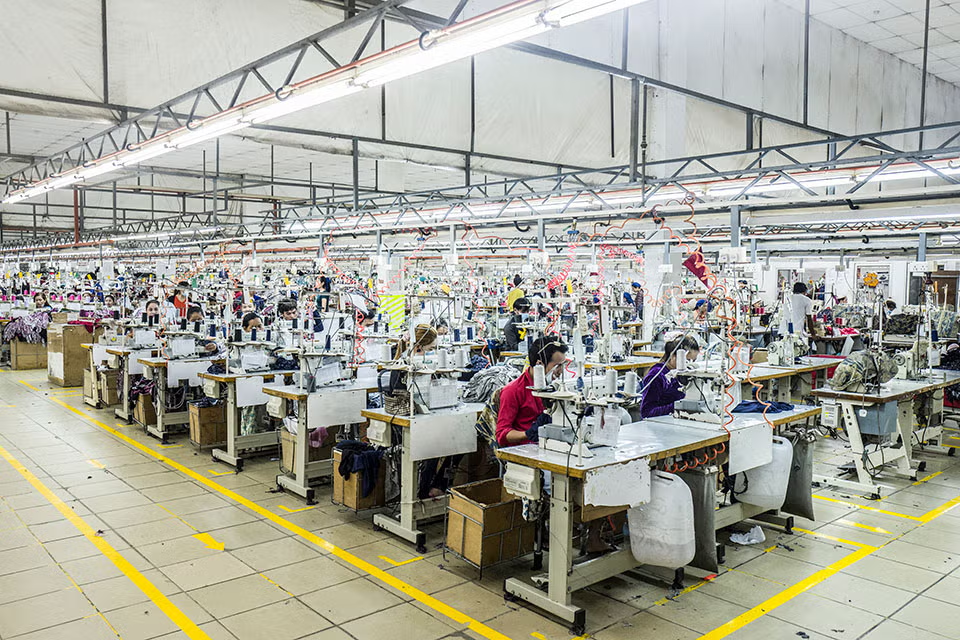
Photo Credit: UN Women Cambodia/Charles Fox |
Supervisors play a pivotal role in garment factories, directly influencing the well-being of the workers they oversee. Workers consistently cite their supervisor’s behavior as a major factor in their job satisfaction. But what do supervisors themselves experience?
Supervisors’ Dual Role
In a recent project, we interviewed supervisors in garment factories in Bangladesh and Cambodia. Their stories reveal a role filled with tension—balancing production quotas, quality control, and team dynamics, all while answering to management. One Bangladeshi supervisor described:
Meeting production targets, maintaining the quality and monitoring the entire team are my main responsibilities… I distribute the targets among the workers and if some targets are missing then I request for extra overtime to my seniors.
As this supervisor describes, the job requires balancing speed and precision. Meeting quotas often means rushing, which can lead to mistakes. Yet, supervisors are held responsible for both output and quality. As a Cambodian team leader stated:
Once a task is completed, the QC team inspects it, and if there’s a mistake, I’m the first one they approach… On top of that, we’re pushed to meet quotas, and that creates tension.
Managing the Team
Supervisors must assign tasks, resolve conflicts, and motivate their teams—all while under pressure. Misunderstandings and resistance are common. One Cambodian team leader noted:
After providing them with a session on what they need to do… they always say they understand… but actually they don’t. It led to problems happening very often.
Another supervisor added:
The worker always said that I am biased… I just assign what the management planned.
Managing people requires emotional intelligence and diplomacy—skills that are often undervalued in factory settings.
Managing Worker Absences
There is one particular, very human problem supervisors face that exemplifies the challenges they must deal with. Workers can be absent from work for multiple reasons: illness or a family emergency, for example. These absences create immediate challenges for supervisors. They must either fill in themselves, reassign workers, or request replacements from management—each option carrying its own risks. One Cambodian supervisor shared:
In case there is an absence from team members, the boss will ask why I allow the team member to take leave and cannot achieve the set quota.
Supervisors are caught in a bind: support their team’s needs or risk being reprimanded. The result is a stressful environment that affects both supervisors and workers.
Gender Dynamics
Gender dynamics also shape how supervisors interact with workers. While some supervisors downplay gender differences, interviews suggest that gender is constantly in play. Tasks are often gendered—women sew, men iron and pack—and interpersonal dynamics vary. A male Cambodian supervisor stated:
Yes, it’s different, as the relationship with women will not be as close as my relationship with men. As I can make more jokes with men than women, and for women I just speak normally without making too many jokes like men.
Female supervisors play a key role in addressing gender-based issues. A female Bangladeshi supervisor put it this way:
One of the reasons why women are made supervisors is so that women’s sexual harassment can be solved… I myself talk to any female worker who is frustrated for any reason, I motivate them so that they can get back to work.
These are just some of the ways that gender dynamics play out between workers and supervisors.
Autonomy Without Real Agency
Supervisors sit between workers and management. They have some autonomy in how they get their work done, but at the end of the day they must manage workers to ensure they meet their quotas. At the same time, they have to “manage up” to secure resources and support to get their work done. While the autonomy supervisors have can be empowering, it also brings stress. Supervisors are held accountable for results but often lack the authority to make meaningful changes.
They also struggle to be heard by those with the power to make meaningful changes. Their suggestions are often dismissed and communication barriers—especially across languages and cultures—make things worse. One Cambodian supervisor shared:
Sometimes we want to suggest something, but our boss doesn’t want to listen… So, we have no choice but to follow accordingly regardless of the difficulties.
Structural Change in Two Parts
Supervisors enjoy leading teams and appreciate the pay—but the stress is real. As one Bangladeshi supervisor put it:
There is always pressure in this job… When the workload is under control, stress also reduces.
Training in how to manage that stress, including how to treat workers well despite the stress, can help but the interviews with supervisors suggest that structural changes are also needed.
Industrial engineering and management studies show that involving workers in the design of production workflows improves worker productivity and well-being. As in many work settings, supervisors in garment factories are in a prime position to identify improvements in workflow that increase worker productivity and decrease defects. This is one part of the structural change that could happen in garment factories: workers and supervisors could be involved in the design of the work they do. A second part is that the gains made through their involvement could be shared with them in the form of higher pay and (relatively) lower production pressure—not all productivity gains need translate into commensurate production increases.
Supporting supervisors means supporting workers. It’s time to rethink how factories are managed—from the ground up.